

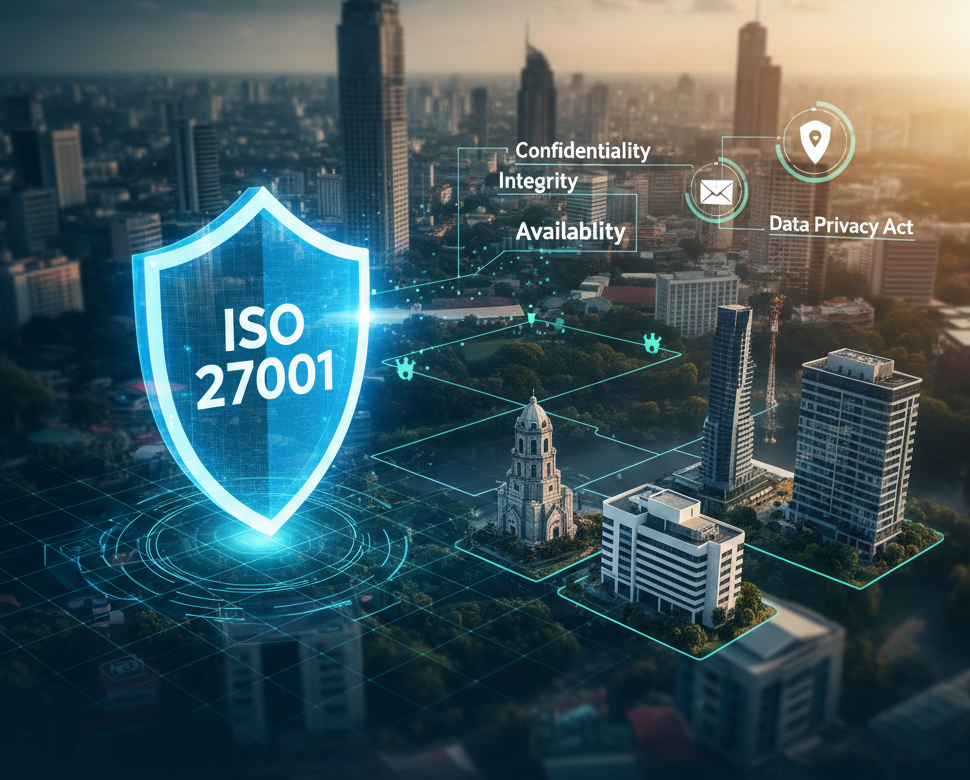

Since the passage of Republic Act No. 10173 — commonly known as the Data Privacy Act (DPA) of 2012 — Philippine companies have faced increasing scrutiny over how they collect, process, and secure personal data. Enforcement by the National Privacy Commission (NPC) has grown stronger each year, and incidents of data breaches involving banks, schools, BPO providers, and digital platforms have pushed regulators to demand better organizational controls, not just written policies.
While many companies attempt compliance by drafting policy manuals and consent forms, one critical element is often overlooked: operational security discipline. This is where ISO 27001, the international standard for Information Security Management Systems (ISMS), becomes a decisive enabler for compliance. ISO 27001 does not replace the DPA, but it provides the structured governance, risk controls, and continuous audit mechanisms needed to align with the law in a demonstrable and defensible way.
Understanding the Data Privacy Act’s Security Obligations
The DPA requires organizations to implement “reasonable and appropriate” security measures to protect personal and sensitive personal information. These obligations cover three major security dimensions:
-
Administrative Security – policies, governance, accountability, and training
-
Technical Security – access management, encryption, network protection, and audit trails
-
Physical Security – facility controls, storage, and asset protection
The challenge for companies is that the DPA does not prescribe the exact controls to use. Instead, it requires organizations to determine, justify, and maintain appropriate safeguards. For many Philippine companies, especially those handling large data volumes or sensitive data, this ambiguity creates uncertainty around what “reasonable” really means. ISO 27001 fills this gap by providing a globally recognized blueprint for managing information security risks.
ISO 27001 as an Operational Framework for DPA Compliance
ISO 27001 defines how to build, operate, and continuously improve an Information Security Management System. For companies subject to the DPA, it provides a structured method to:
-
Identify information security risks
-
Implement safeguards proportionate to those risks
-
Monitor, measure, and audit the controls
-
Prove due diligence to regulators, auditors, and customers
This operationalization is what most companies fail to achieve when they rely on documentation alone. The NPC increasingly expects evidence of implementation, not just paperwork.
ISO 27001 Aligns with the DPA’s Security Principle Requirements
The DPA outlines several security principles, including confidentiality, integrity, availability, accountability, and data minimization. ISO 27001 translates these abstract principles into actionable processes such as risk assessments, asset classification, access control management, incident handling, and internal ISMS audits.
This alignment means a company can justify, with documentation and records, that its controls are not just policy statements but operational realities.
Structured Risk Assessment Instead of Guesswork
ISO 27001 requires a formal information security risk assessment, which is rarely practiced in Philippine firms without a framework. Companies must identify the data they hold, understand who can access it, analyze threat scenarios (internal and external), and determine how those risks can be mitigated.
For DPA compliance, this eliminates the subjective question of “Have we done enough?” and replaces it with a defensible, measurable process that determines the adequacy of controls.
Clear Accountability Through Defined Roles and Responsibilities
The DPA mandates the appointment of a Data Protection Officer (DPO), but many enterprises file the designation and stop there. ISO 27001 extends this requirement by defining roles for data custodians, system owners, incident responders, auditors, and risk managers.
This division of responsibilities ensures that personal data protection is not confined to the DPO alone, but embedded into operations, IT, HR, and compliance functions — making accountability practical rather than symbolic.
Documented Controls, Policies, and Procedures That Stand Up to Audits
Compliance is not just about having policies; it is about maintaining controlled documents that reflect current operations and undergo scheduled reviews. ISO 27001 enforces this through document management rules, version control, audit trails, and retention policies.
This matters during DPA compliance checks because the NPC frequently requests documentation to verify that policies are not theoretical but consistently implemented and updated.
Incident Reporting and Breach Response Readiness
The DPA mandates breach reporting within 72 hours for incidents involving personal data. Without a structured security incident response mechanism, this timeframe is nearly impossible to meet — especially for breaches discovered late.
ISO 27001 introduces formal incident classification, escalation paths, communication procedures, evidence logs, and corrective actions. This transforms breach response from a reactive scramble into a controlled, documented process aligned with legal reporting obligations.
Regular Internal Audits and Continuous Improvement
Unlike one-time compliance checklists, ISO 27001 embeds continuous improvement through internal audits, management reviews, and corrective actions. These audits prevent the “set and forget” problem that often plagues policy-driven compliance.
For the NPC, the ability to show ongoing internal audit records demonstrates sustained compliance rather than one-time compliance — a major differentiator during investigations or inspections.
Bridging Compliance with Real Operational Security
Many Philippine companies initially approach the DPA as a legal documentation requirement, only to realize that the bulk of compliance lies in operations and security controls. ISO 27001 bridges this gap by connecting legal compliance obligations with:
-
IT security practices
-
data governance structure
-
vendor and third-party risk management
-
staff awareness and training
-
business continuity planning
This integration reduces the exposure created by relying solely on policy documents without operational controls.
Reducing Legal, Financial, and Reputational Exposure
Failure to comply with the DPA can lead to administrative fines, criminal liability, and reputational damage. While enforcement in early years focused heavily on awareness, recent enforcement trends show the NPC demanding accountability after breaches involving banks, educational institutions, and healthcare providers.
ISO 27001 certification provides a defensible position that a company exercised reasonable diligence, which can mitigate penalties and strengthen an organization’s legal posture in breach-related investigations.
Improved Trust and Assurance for Stakeholders
Clients, investors, data subjects, and regulators increasingly expect proof that organizations can handle sensitive personal information responsibly. ISO 27001 certification demonstrates that a company has undergone an external audit and is subject to annual surveillance audits, making the organization’s security posture credible rather than claimed.
Even without full certification, alignment with ISO 27001 strengthens assurances that the company is not merely complying on paper but managing data with operational discipline.
Preparing for Digital Transformation and Cross-Border Requirements
Philippine businesses are rapidly adopting digital platforms, cloud services, fintech tools, and remote workforce arrangements. Each introduces new attack surfaces and data flows subject to the DPA. ISO 27001 provides governance for these transitions, ensuring that security and privacy controls evolve with the organization.
As cross-border data transfers continue, ISO-aligned security controls make it easier to negotiate with international partners who require proof of data protection maturity.
Conclusion
ISO 27001 is not a replacement for the Data Privacy Act of 2012, but it provides the missing operational discipline required to meet the law’s security mandates. By defining a structured risk management approach, assigning clear accountability, implementing documented controls, preparing for breaches, and enforcing continuous improvement, ISO 27001 transforms compliance from a paperwork exercise into a resilient, monitored, and auditable system.
For Philippine companies handling personal, sensitive, or financial data, alignment with ISO 27001 represents not only regulatory compliance, but a strategic investment in organizational security and trustworthiness.


