

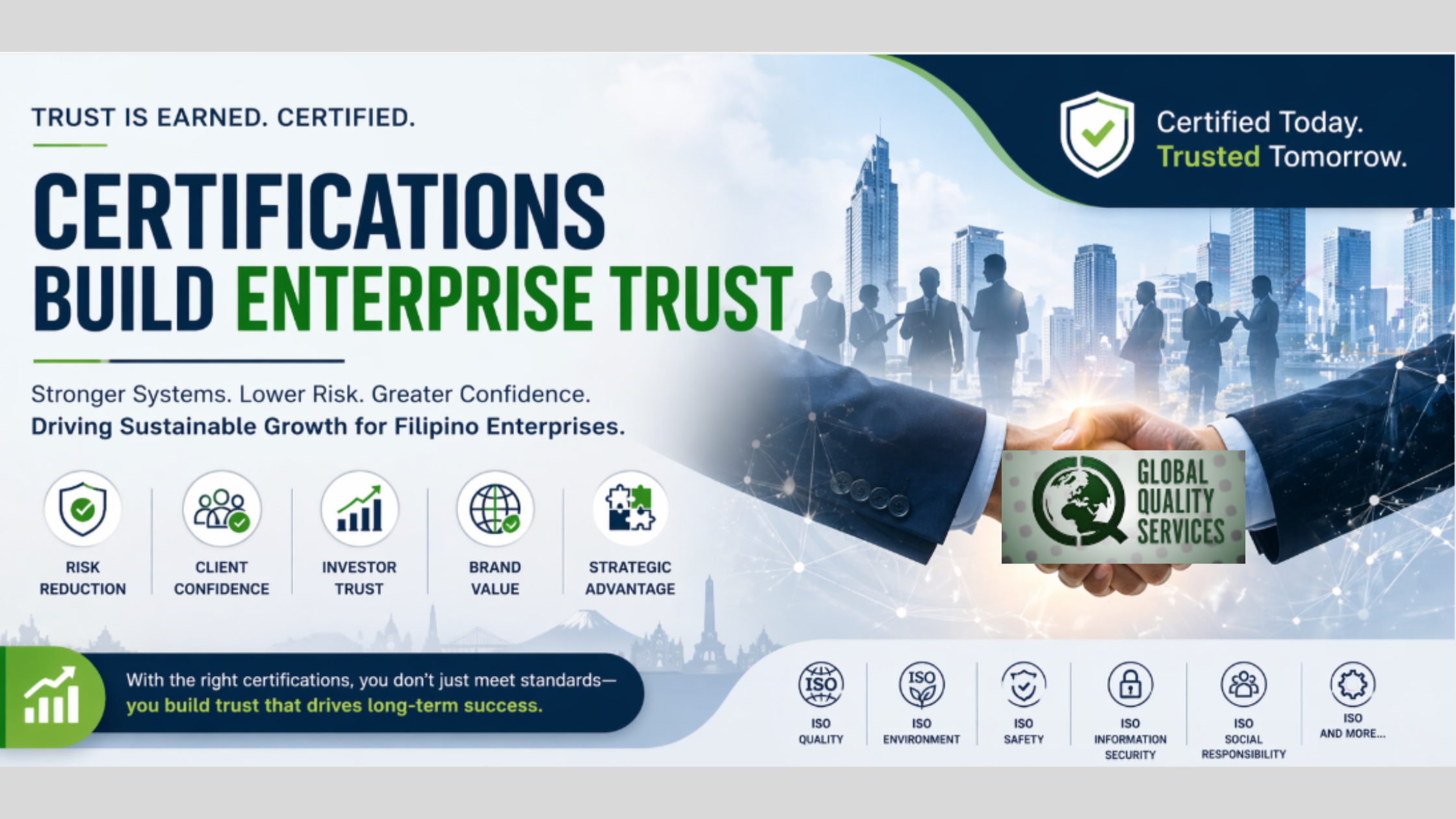

Trust today is audited, verified, and documented. In the Philippine business environment, certifications have shifted from operational checklists to strategic assets that influence how enterprises are evaluated by clients, regulators, and investors.
As organizations engage with global partners and operate under increasing regulatory scrutiny, the expectation is clear—businesses must demonstrate structured systems rather than informal processes. Certifications provide that assurance. They show that an organization’s practices are consistent, monitored, and aligned with recognized standards. For CXOs, this transforms certifications into a core element of enterprise trust.
The Philippine Context: Why Trust Needs Proof
The Philippines continues to attract foreign investment and expand its role in global supply chains. According to the Philippine Statistics Authority, foreign investments approved in recent years have shown steady growth, signaling increased global participation in the local economy.
At the same time, regulators are tightening oversight across industries:
- The Department of Environment and Natural Resources enforces environmental compliance standards
- The National Privacy Commission regulates data protection under the Data Privacy Act
- The Department of Labor and Employment monitors workplace safety and labor compliance
This dual pressure—global expectations and local enforcement—means trust must be demonstrated, not assumed. Certifications act as a bridge between these expectations.
Risk Reduction Through Structured Systems
At the leadership level, unmanaged risk is one of the biggest threats to stability. Certifications introduce structure into operations, reducing reliance on informal decision-making.
They require organizations to:
- Document processes and controls
- Identify operational and compliance risks
- Implement corrective and preventive actions
- Monitor performance through audits
This systematic approach minimizes exposure to regulatory penalties, operational failures, and reputational damage.
For example, compliance failures in environmental or data protection areas can result in fines, operational disruption, or loss of client trust. Certifications help prevent these outcomes by enforcing accountability and consistency.
For CXOs, this creates a shift from reactive management to proactive governance.
Client Confidence That Converts Into Business
Procurement processes have become more rigorous. Clients, especially international ones, increasingly require proof that vendors meet defined standards.
Certifications provide that proof.
They serve as third-party validation that:
- Systems are reliable and consistent
- Risks are controlled
- Compliance requirements are met
In many sectors, certifications are now part of vendor qualification criteria. Without them, organizations may not even enter the evaluation stage.
This has direct commercial impact:
- Faster deal closures due to reduced due diligence
- Higher win rates in competitive bids
- Stronger client retention due to demonstrated reliability
For Philippine enterprises working with global clients, certifications often move from being a differentiator to a baseline requirement.
Investor Trust and Governance Alignment
Investors are increasingly focused on governance, risk, and sustainability—not just financial returns. Certifications provide a structured way to demonstrate maturity in these areas.
According to the Bangko Sentral ng Pilipinas and ESG-related disclosures encouraged across financial ecosystems, organizations are expected to show transparency and risk management capabilities.
Certifications support this by:
- Demonstrating internal control systems
- Aligning operations with global frameworks
- Reducing perceived investment risk
They also play a role in ESG positioning. Environmental, social, and governance factors are now part of investment decisions, and certifications act as tangible indicators of compliance.
For CXOs, this strengthens investor confidence and supports long-term access to capital.
Brand Value Backed by Verifiable Credibility
Brand perception is no longer driven only by marketing. Stakeholders expect evidence behind claims.
Certifications shift brand positioning from “we follow best practices” to “we are independently verified to meet them.”
This matters in the Philippines, where:
- Competition is increasing across sectors
- Buyers are more informed
- Regulatory scrutiny is higher
A certified organization signals discipline, reliability, and accountability. This strengthens trust across clients, partners, and regulators.
It also supports external communication—PR, partnerships, and stakeholder engagement—by providing credible proof points.
Real-World Operational Outcomes
Certifications are often seen as compliance exercises, but their real value lies in operational improvement.
Structured systems lead to:
- Reduced waste and improved efficiency
- Better resource utilization
- Clear accountability across teams
- Consistent output quality
For example, organizations implementing structured management systems often report measurable improvements in process efficiency and cost control due to reduced rework and better planning.
In the Philippine manufacturing and services sectors, where margins can be tight, these improvements directly impact profitability. For CXOs, certifications become tools for performance optimization—not just compliance.
Strategic Positioning in Competitive Markets
Certifications influence how organizations are positioned in the market. They open access to opportunities that require demonstrated capability.
These include:
- Government tenders and regulated projects
- Multinational supply chain participation
- Enterprise-level contracts
The Department of Trade and Industry actively promotes quality and standards adoption to improve global competitiveness of Filipino businesses. Certifications align directly with this objective. Organizations that invest in certifications are better positioned to scale, expand, and compete internationally.

Regulatory Alignment and Compliance Confidence
Compliance is becoming more complex. Different industries face different requirements, and these requirements continue to evolve.
Certifications provide a structured way to stay aligned.
They ensure that organizations:
- Monitor applicable laws and regulations
- Integrate compliance into daily operations
- Maintain audit readiness
For example, the Environmental Management Bureau under DENR enforces environmental regulations that require consistent monitoring and reporting. Certified systems help organizations meet these obligations efficiently. This reduces the risk of non-compliance and builds confidence during regulatory inspections.
Sustainability and Long-Term Business Alignment
Sustainability is no longer optional. It is becoming a core expectation from regulators, investors, and clients.
Certifications help organizations integrate sustainability into their operations in a structured way.
They require:
- Identification of environmental and social impacts
- Setting measurable objectives
- Continuous monitoring and improvement
In the Philippines, where environmental challenges and regulatory focus are increasing, this alignment is critical. Organizations that adopt certified systems are better prepared to meet future requirements and stakeholder expectations.
Final Takeaway for CXOs
Certifications are not just operational tools—they are trust frameworks. In the Philippines, where businesses operate at the intersection of local regulation and global expectations, trust must be demonstrated through structured systems and verified processes.
For CXOs, certifications deliver value across multiple dimensions:
- Risk reduction through standardized operations
- Client confidence that supports revenue growth
- Investor trust through governance and transparency
- Brand value backed by independent validation
- Strategic positioning for long-term competitiveness
The focus should not be on certification as a one-time achievement, but as an ongoing system that strengthens how the organization operates. In a market where credibility directly impacts opportunity, certifications are no longer optional—they are foundational to enterprise trust. Contact us at Global Quality Services to know more about the importance and How Certifications Build Enterprise Trust in the Philippines.


