

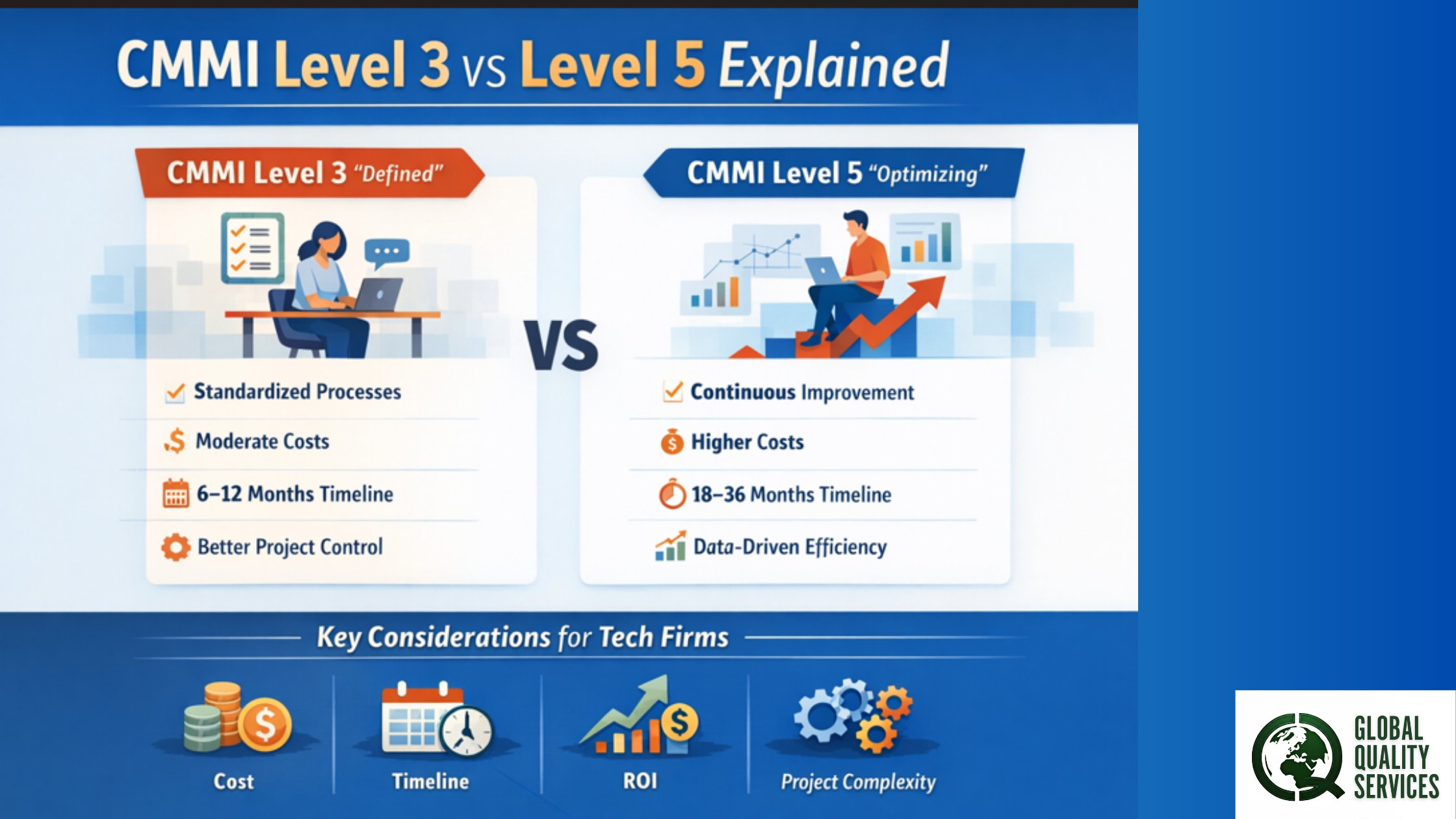

For mid-to-large tech firms, CMMI maturity is no longer just a compliance badge. It directly affects delivery predictability, client confidence, and long-term scalability.
The real question most leadership teams face is not whether to pursue CMMI, but whether Level 3 is enough or Level 5 is worth the extra investment.
This guide breaks down CMMI Level 3 vs Level 5 in practical terms: what actually changes on the ground, how costs and timelines differ, where ROI shows up, and which level fits different types of organizations.
What Is CMMI, Briefly
CMMI (Capability Maturity Model Integration) is a globally recognized framework for assessing and improving process maturity across software development, IT services, and product engineering.
The model has five maturity levels, with Level 3 and Level 5 being the most common targets for established tech firms.
Quick Snapshot: CMMI Level 3 vs Level 5
| Aspect | CMMI Level 3 | CMMI Level 5 |
|---|---|---|
| Focus | Defined & standardized processes | Continuous optimization & performance |
| Data usage | Basic metrics | Advanced statistical analysis |
| Predictability | Medium–High | Very High |
| Process flexibility | Defined but stable | Adaptive and data-driven |
| Typical adopters | Growing or scaling firms | Large, mature delivery organizations |
| Client perception | Process-driven & reliable | Elite, highly mature delivery |
CMMI Level 3 Explained
CMMI Level 3 is called the “Defined” level.
At this stage, the organization has moved beyond team-specific practices and established organization-wide standard processes.
What Level 3 Looks Like in Practice
-
Processes are documented, trained, and consistently followed
-
Project management, QA, and engineering teams work from the same playbook
-
Deviations are controlled rather than ad-hoc
-
Success no longer depends on individual heroes
Typical Benefits
-
Better project predictability
-
Fewer delivery surprises
-
Easier onboarding of new teams
-
Stronger credibility with enterprise clients
For many mid-size tech firms, Level 3 is the point where chaos turns into control.
CMMI Level 5 Explained
CMMI Level 5 is the “Optimizing” level and represents the highest maturity.
Here, processes are not just followed—they are continuously improved using data and statistical insight.
What Level 5 Looks Like in Practice
-
Performance is measured using advanced metrics
-
Root causes of defects and delays are statistically analyzed
-
Processes evolve proactively, not reactively
-
Teams optimize for long-term outcomes, not just project success
Typical Benefits
-
Very high delivery predictability
-
Measurable reduction in defects and rework
-
Continuous cost optimization
-
Strong differentiation in global bids and audits
Level 5 is usually pursued by firms operating at large scale, across regions, with complex delivery portfolios.
Cost Comparison: Level 3 vs Level 5
Cost is one of the biggest decision drivers.
CMMI Level 3 Cost (Typical Range)
-
Consulting & gap analysis
-
Process documentation & training
-
Appraisal fees
Estimated investment: Moderate and predictable
Often achievable without disrupting ongoing delivery
CMMI Level 5 Cost (Typical Range)
-
Everything in Level 3, plus
-
Advanced metrics systems
-
Statistical process control
-
Long-term optimization programs
Estimated investment: Significantly higher
Requires dedicated quality and process leadership
Key insight:
Level 5 costs are not just upfront—they are ongoing, because optimization never stops.
Timeline Comparison
Level 3 Timeline
-
Usually 6 to 12 months
-
Faster if some structure already exists
-
Clear milestones and closure
Level 5 Timeline
-
Often 18 to 36 months
-
Depends heavily on data maturity
-
No “finish line” mindset—continuous cycle
If leadership expects quick certification for market credibility, Level 3 aligns better with realistic timelines.
ROI: Where Each Level Pays Off
ROI from CMMI Level 3
-
Reduced delivery variance
-
Better utilization of teams
-
Faster client trust in audits
-
Improved win rate for enterprise deals
ROI is usually visible within 1–2 years.
ROI from CMMI Level 5
-
Lower defect costs at scale
-
Improved margins over time
-
Strong positioning in global RFPs
-
Long-term operational efficiency
ROI here is strategic and cumulative, not immediate.
Project Complexity: Which Level Fits What?
Level 3 Fits Best If:
-
Projects are medium to large
-
Teams are growing fast
-
Clients demand process maturity
-
Delivery is structured but not highly volatile
Level 5 Fits Best If:
-
Projects are highly complex or mission-critical
-
Delivery spans geographies and vendors
-
Data-driven optimization is already part of culture
-
Leadership wants long-term operational excellence
Simple rule:
If your biggest problem is consistency, choose Level 3.
If your biggest problem is efficiency at scale, Level 5 makes sense.
Which CMMI Level Should You Choose?
Ask these questions honestly:
-
Are our processes stable enough to measure meaningfully?
-
Do we actively use data to improve outcomes today?
-
Is CMMI mainly for client confidence or internal optimization?
-
Do we have leadership bandwidth for long-term transformation?
For most mid-to-large tech firms, Level 3 is a strong, defensible milestone.
Level 5 works best when Level 3 has already delivered measurable results.
FAQs: Common Questions About CMMI Level 3 vs Level 5
Is CMMI Level 5 mandatory after Level 3?
No. Many organizations stay at Level 3 for years and still operate successfully at scale.
Does Level 5 guarantee better delivery?
It improves predictability and efficiency, but only if data quality and culture support it.
Can a company jump directly to Level 5?
In theory, yes. In practice, it is rare and risky without Level 3 maturity.
Is CMMI still relevant in Agile or DevOps environments?
Yes. CMMI focuses on process maturity, not rigid methodology. Agile teams can be CMMI compliant.
Which level do enterprise clients usually expect?
Most enterprise buyers are satisfied with CMMI Level 3. Level 5 is often a differentiator, not a requirement.
Final Thoughts
CMMI Level 3 and Level 5 serve different business goals.
Level 3 brings structure, predictability, and credibility.
Level 5 brings optimization, efficiency, and long-term performance control.
Choosing the right level is less about ambition and more about organizational readiness and business strategy.
Organizations that align CMMI maturity with real delivery needs tend to see the strongest results over time.
If you’re evaluating where your organization fits today, starting with an honest process assessment from Global Quality Services usually brings more clarity than chasing the highest level on paper.


