

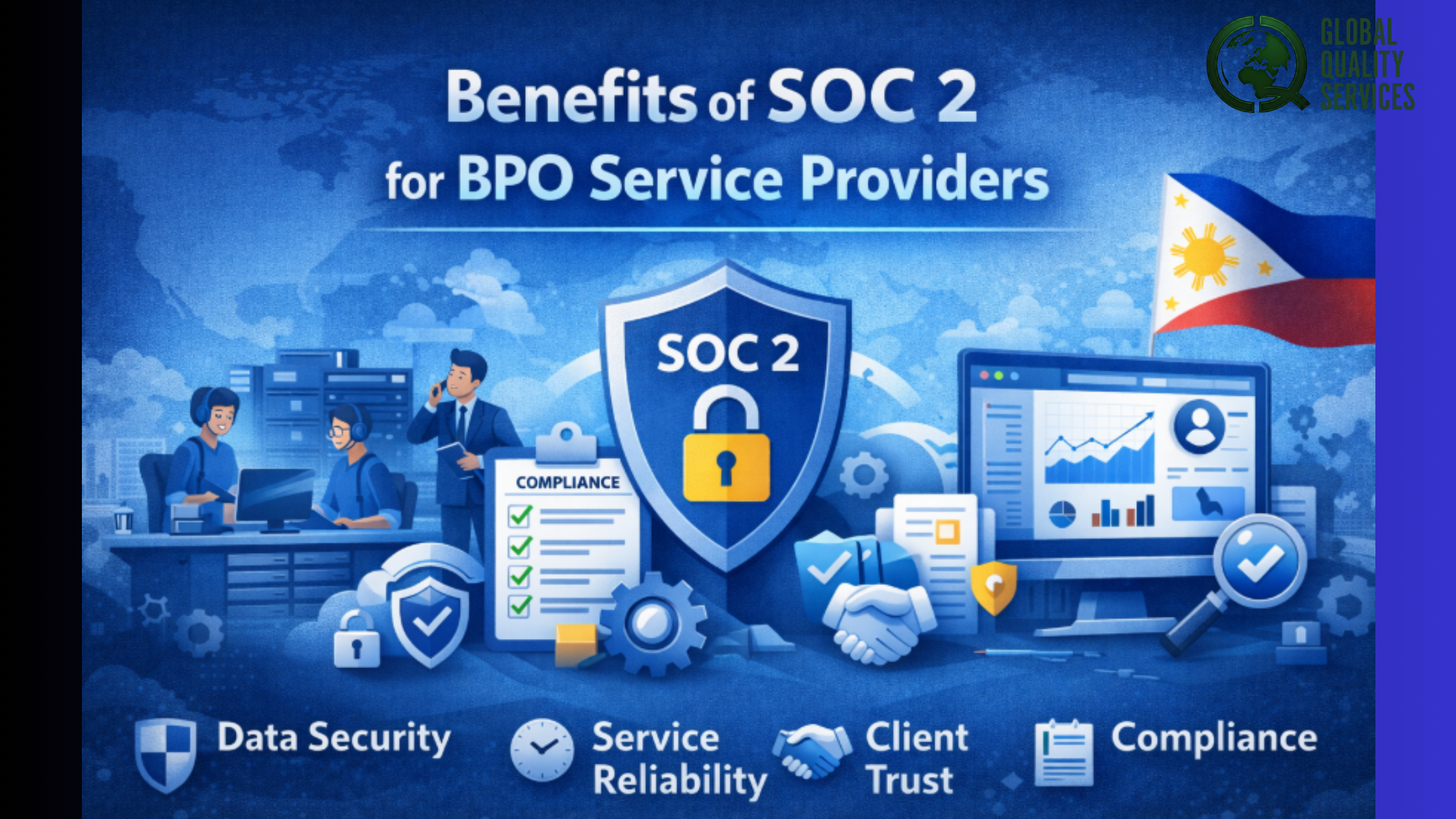

The Philippine BPO sector has grown far beyond voice support and simple back-office work. Today, many BPO providers handle customer support data, payroll records, HR files, healthcare information, financial workflows, SaaS back-end operations, and other business-critical processes for overseas clients. That shift has changed what buyers expect from their outsourcing partners. Low cost and English proficiency still matter, but for serious contracts, they are no longer enough.
Clients now want proof that a BPO provider can protect data, control access, respond to incidents, and run dependable systems at scale. That is where SOC 2 becomes valuable. In strict technical terms, SOC 2 is an attestation framework and report, not a government-issued certification. But in day-to-day business language, many buyers still refer to it as “SOC 2 certification.” The substance is what matters: an independent auditor evaluates whether a service organization’s controls are designed, and in Type II engagements operating, to meet the relevant Trust Services Criteria.
For BPO providers in the Philippines, SOC 2 is especially relevant because outsourcing almost always involves entrusted data. A provider may act as a processor of customer records, employee information, support tickets, call recordings, payment-related details, or internal business data belonging to a foreign client. Under the Philippines’ Data Privacy Act of 2012, the State recognizes the need to secure and protect personal information in ICT systems in both the public and private sectors.
The law also has extra-territorial reach in certain cases, including where there is a Philippine link and where processing concerns Philippine citizens or residents, even if some processing happens outside the country. That makes disciplined controls more than a best practice; they become part of a broader compliance posture for export-oriented service firms.
What SOC 2 actually covers
SOC 2 is built around the AICPA Trust Services Criteria: security, availability, processing integrity, confidentiality, and privacy. A service organization does not always scope all five, but security is the baseline most buyers expect, and many engagements also include confidentiality, availability, and privacy depending on the nature of the outsourced work. For a BPO provider, these criteria map neatly to real-world client concerns: who can access systems, whether services stay available, whether outputs are accurate, whether client information is restricted to authorized use, and whether personal data is handled properly.
That is why SOC 2 carries weight in vendor reviews. It does not merely say a company cares about security. It requires a defined system description, documented controls, and independent examination. For buyers comparing multiple outsourcing vendors in the Philippines, that independent assurance can shorten security questionnaires, reduce procurement friction, and make the BPO provider easier to approve internally.

1. SOC 2 helps BPO providers win larger and better clients
One of the biggest benefits of SOC 2 is commercial. Mid-market and enterprise clients increasingly expect an assurance report before they outsource sensitive work. This is particularly true in industries such as SaaS, fintech, healthcare support, HR outsourcing, customer service operations, and finance back-office processing, where the BPO partner may access regulated or business-sensitive information. A SOC 2 report gives procurement, legal, IT, and security teams something concrete to review. Instead of relying on marketing claims, the client can examine an auditor-tested control environment.
For Philippine BPO providers, this can directly affect deal size and deal quality. Providers without SOC 2 often remain stuck in lower-trust, price-sensitive engagements. Providers with a credible SOC 2 posture are better positioned for longer contracts, higher-value accounts, and relationships where trust and resilience matter as much as hourly rates. In practice, SOC 2 helps move the conversation from “Can you do the work cheaply?” to “Can we trust you with critical operations?” That is a major shift in positioning.
2. SOC 2 strengthens compliance alignment with Philippine privacy law
SOC 2 is not a substitute for Philippine law, but it supports many of the operational disciplines that BPO firms need under the Data Privacy Act and its IRR. The NPC’s IRR says the Rules adopt generally accepted international principles and standards for personal data protection, and it imposes obligations on personal information processors in addition to what is required by contract. It also requires registration and compliance actions in certain cases, including annual reporting of documented security incidents and personal data breaches.
This matters for BPO providers because they often operate as personal information processors on behalf of client organizations. SOC 2 pushes them to formalize controls around access, change management, logging, risk assessment, vendor oversight, and incident response.
Those are the same operational areas that tend to create exposure under privacy law when they are weak or undocumented. The result is that SOC 2 can make DPA compliance easier to demonstrate and manage, even though the two frameworks are not identical.
The breach side is especially important. The NPC’s breach reporting guidance stresses security measures, response procedures, mitigation steps, and compliance with breach-notification obligations. It also says the obligation to notify remains with the personal information controller even if processing is outsourced.
That means clients care deeply about whether their BPO partner can detect, contain, investigate, and document an incident quickly. A mature SOC 2 environment gives confidence that the provider can support that process instead of becoming the weak link.
3. SOC 2 improves internal operations, not just external optics
A shallow reading of SOC 2 treats it as a sales badge. In reality, its deeper value is operational. Many BPO firms grow quickly, add shifts, spin up new accounts, onboard temporary staff, grant tool access fast, and rely on a mix of client systems and in-house platforms. That kind of growth can create control sprawl. Access rights stay active too long. Exceptions are approved informally. Logs exist but are not reviewed.
Vendor risk is assumed rather than evaluated. Business continuity plans exist on paper but are not tested. SOC 2 forces management to tighten these weak points.
For a BPO provider, that discipline shows up in day-to-day execution. User provisioning becomes clearer. Role-based access improves. Terminations and transfers are handled more cleanly. Incident escalation paths become defined. Change approvals become traceable.
Training becomes easier to standardize. All of this reduces avoidable mistakes. That matters because outsourcing operations are people-heavy by nature, and people-heavy environments are where control failures often happen.
4. SOC 2 gives clients confidence in cross-border outsourcing
A major reason foreign clients outsource to the Philippines is the depth of talent and service culture. A major reason they hesitate is data risk. They worry about cross-border transfers, remote access, subcontractors, endpoint security, insider threats, and service continuity.
The DPA itself reflects this reality by covering processing with Philippine links and by emphasizing the protection of personal data in information systems. The DICT’s National Cybersecurity Plan 2023–2028 likewise frames cybersecurity around the protection of confidentiality, integrity, and availability.
SOC 2 helps answer that cross-border trust problem in a language global buyers already understand. A US client, for example, may not know the details of Philippine outsourcing operations, but it does understand the value of an independent SOC 2 report.
That report becomes a shared assurance artifact between the client’s security team and the BPO provider. It reduces uncertainty and gives both sides a common basis for discussing control design, exceptions, user access, subservice organizations, and incident handling.
5. SOC 2 makes contract negotiations smoother
In outsourcing deals, the contract stage often becomes a security negotiation. Clients ask for audit rights, breach-notification timelines, subcontractor disclosures, access restrictions, encryption expectations, backup commitments, and evidence of internal controls. If a provider has no structured assurance framework, every deal becomes a custom debate. That slows sales and increases legal overhead.
SOC 2 does not eliminate negotiation, but it makes the provider’s control environment easier to explain and defend. Instead of answering hundreds of ad hoc questions from scratch, the provider can map many responses to an existing control set and report scope.
That makes questionnaires faster to complete and reduces the chance of inconsistent answers across sales, operations, and IT. For fast-scaling BPO firms, that efficiency is a genuine commercial advantage.
6. SOC 2 supports resilience, uptime, and service continuity
Clients do not outsource only to save money. They outsource to achieve reliable execution. For BPO operations, outages can be expensive: support queues back up, service levels are missed, tickets pile up, payroll deadlines slip, and client trust drops quickly.
SOC 2’s availability and security criteria push providers to formalize backup, recovery, monitoring, access control, and incident response practices.
This is where SOC 2 becomes broader than privacy. A provider may avoid a data breach but still fail a client if it cannot maintain operations or recover quickly from disruption.
BPO buyers increasingly want partners that can show not just safe handling of information, but reliable and repeatable delivery. SOC 2 helps connect those two ideas. Strong controls support both security and service continuity.
7. SOC 2 helps management build a stronger risk culture
One overlooked benefit of SOC 2 is governance. The framework forces leaders to pay attention to issues that growing BPOs often postpone: risk ownership, evidence retention, policy maintenance, segregation of duties, vendor oversight, exception handling, and periodic review. It makes security less dependent on a few technical staff and more embedded in management routines.
That cultural shift matters because many serious incidents do not begin with advanced hacking. They begin with ordinary weaknesses: overbroad permissions, poor offboarding, unreviewed shared accounts, missing logs, weak onboarding, or delayed escalation.
SOC 2 addresses those mundane but dangerous issues by requiring control maturity, evidence, and accountability. Over time, that can make a BPO provider not just more compliant, but more professionally managed.
Conclusion
For Philippine BPO providers, SOC 2 is not just a foreign framework imported for marketing value. It is a practical trust mechanism for an industry built on handling other companies’ data, systems, and business processes. It supports stronger privacy alignment under the Data Privacy Act, improves breach readiness, reduces procurement friction, strengthens client confidence in cross-border outsourcing, and raises internal operating discipline.
The biggest benefit is not the report itself. It is what the report signals: this provider has taken security, reliability, and governance seriously enough to be independently examined. In a market where buyers are increasingly cautious about third-party risk, that can be the difference between being shortlisted and being ruled out early. Want to experience it yourself? Connect with us at Global Quality Services.


