

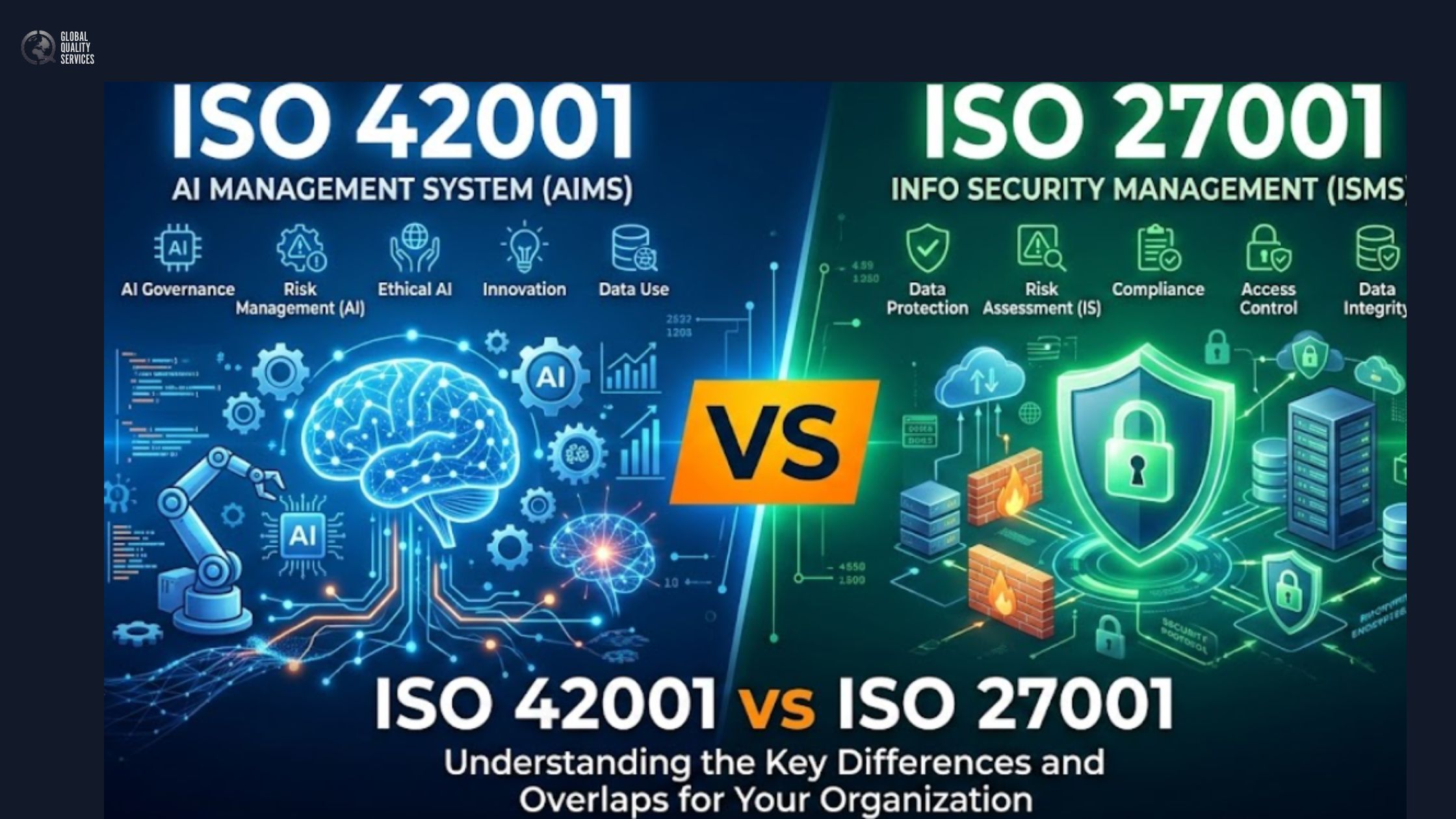

In the current technological epoch, where “AI-powered” is the default setting for innovation, a critical question faces every CTO and Compliance Officer: Is our security framework actually built for the intelligence we are deploying?
For two decades, ISO/IEC 27001 has been the undisputed fortress of the digital world. It told the world your data was safe. However, the rise of Large Language Models (LLMs), predictive analytics, and autonomous systems has introduced risks that traditional firewalls cannot catch. This led to the birth of ISO/IEC 42001, the first international standard for Artificial Intelligence Management Systems (AIMS).
As a “2-star” company looking to elevate your status to global leadership, understanding the deep-tissue differences and the strategic overlaps between these two standards is not just a compliance task—it is a business imperative.
Philosophical Divergence: The “What” vs. The “How”
To grasp the complexity, we must first look at the core intent of each standard.

ISO 27001: The Guardian of Assets
ISO 27001 is designed to manage Information Security. It views data as an asset—a “thing” that needs to be locked away. Its primary framework is the CIA Triad:
-
Confidentiality: Ensuring only authorized eyes see the data.
-
Integrity: Ensuring the data isn’t tampered with.
-
Availability: Ensuring systems are up when needed.
ISO 42001: The Architect of Behavior
ISO 42001 is designed to manage Artificial Intelligence. It views AI not just as data, but as a process of decision-making. It moves beyond the CIA triad to address the socio-technical impact of AI. Its primary framework is based on Trustworthiness:
-
Transparency: Can we see how the decision was made?
-
Explainability: Can a human understand the logic?
-
Fairness: Is the model biased against certain demographics?
-
Accountability: Who is responsible when the model “hallucinates”?
The Structural Intersection: Annex SL
Despite their different targets, both standards are built on the Annex SL high-level structure. This is a massive advantage for tech companies. It means Clauses 4 through 10 are identical in title and basic requirement.
-
Context of the Organization (Clause 4): Both require you to define your boundaries. In 27001, you define your Data Environment. In 42001, you define your AI System Lifecycle.
-
Leadership (Clause 5): Both demand C-suite accountability. You cannot delegate a “2-star” compliance effort to a junior IT tech; it must come from the top.
-
Support & Resources (Clause 7): Both require proof that your team is actually competent to manage these systems.
Strategic Insight: If you have ISO 27001, you have already built the “Management System” muscles. Adding ISO 42001 is like adding a new specialized workout to an existing fitness routine.
Technical Deep Dive: Comparing the Annexes
The real “meat” of these standards lies in their controls. This is where the 1,200-word complexity truly reveals itself.
ISO 27001 Annex A (93 Controls)
The 2022 update of ISO 27001 organized controls into four themes: Organizational, People, Physical, and Technological.
-
Control A.8.10 (Data Masking): Focuses on obscuring PII so hackers can’t use it.
-
Control A.8.1 (User Endpoints): Focuses on securing the laptops and phones that access the network.
-
Control A.5.7 (Threat Intelligence): Focuses on knowing what external hackers are planning.
ISO 42001 Annex A (39 Controls)
ISO 42001 controls are specifically mapped to the AI lifecycle (Inception, Development, Deployment, Monitoring, Retirement).
-
Control A.2 (AI Governance Policy): Requires a specific policy on how AI will be used ethically—standard IT policies are insufficient here.
-
Control A.5.2 (Data for AI Systems): This is deeper than “security.” It asks: Is the training data high quality? Is it “poisoned”? Is it legally sourced?
-
Control A.8.3 (Explainability): This requires technical mechanisms (like SHAP or LIME values) to explain why a model made a specific prediction.
The “Security Gap”: Why ISO 27001 Fails AI
Many tech firms believe their ISO 27001 certificate protects them from AI risk. This is a dangerous misconception. Let’s look at three scenarios where 27001 is “blind” but 42001 provides a shield:
Scenario A: The Biased Algorithm
A fintech company uses AI to approve loans with Global Quality Services. The system is perfectly encrypted (ISO 27001 compliant). However, the training data was historically biased, leading the AI to reject minority applicants at a higher rate.
-
ISO 27001 Result: Pass. The data was confidential and integral.
-
ISO 42001 Result: Fail. Lack of bias mitigation and fairness controls.
Scenario B: Model Drift
A healthcare AI predicts patient outcomes. Over six months, the incoming patient data changes, and the model’s accuracy drops from 95% to 60%.
-
ISO 27001 Result: Pass. The server is still “Available.”
-
ISO 42001 Result: Fail. Lack of continuous monitoring and re-validation procedures.
Scenario C: Prompt Injection
A competitor uses a “jailbreak” prompt to make your corporate chatbot reveal its internal system instructions and underlying training data.
-
ISO 27001 Result: Likely Pass. No traditional “firewall” was breached.
-
ISO 42001 Result: Fail. Lack of adversarial robustness testing.
The Integrated Management System (IMS)
For companies striving for efficiency, the answer is an Integrated Management System. Instead of two separate sets of documents, you create a unified framework.
-
One Risk Register: You track “Ransomware” next to “Algorithmic Bias.”
-
One Internal Audit: You check your firewall settings and your model validation logs in the same week.
-
One Management Review: Your board reviews both security posture and AI ethical performance.
This approach reduces the compliance burden by approximately 40% compared to running the two standards in silos.
Conclusion
Navigating the dual complexities of ISO 27001 and ISO 42001 requires more than just a checklist; it requires a partner with a global footprint and localized expertise. Global Quality Services (GQS) stands at the forefront of this transition, serving as a premier consultancy firm for tech companies across India, the Philippines, and Indonesia. With a proven track record in delivering approved lead auditor training and implementation support, GQS specializes in bridging the gap between operational status and world-class certification.
Whether you are an AI-native startup or a legacy firm integrating machine learning, GQS provides the technical rigor needed to map 27001’s infrastructure controls to 42001’s algorithmic ethics. Their consultants don’t just prepare you for an audit; they help you build a resilient, Integrated Management System (IMS) that turns compliance into a measurable competitive advantage.
Frequently Asked Questions (The “Nitty-Gritty”)
Q: Does ISO 42001 require us to open-source our code?
A: No. Transparency doesn’t mean “giving away your IP.” It means having internal documentation that explains the model’s logic and being able to provide “Explainability” to relevant stakeholders (like regulators) when required.
Q: We use third-party AI APIs. Are we exempt?
A: No. You are an “AI User.” ISO 42001 requires you to perform Due Diligence on your AI vendors. If you build an app on an unethical or unstable API, your company carries the reputational and legal risk.
Q: How does this relate to the EU AI Act?
A: ISO 42001 was designed to be the “harmonized standard” for the EU AI Act. If you want to sell your AI in Europe, this certification will be your most powerful piece of evidence for compliance.
Q: What is the cost for a mid-sized firm?
A: In 2026, for a firm with 50-100 employees, an integrated 27001/42001 audit typically ranges from $15,000 to $35,000, excluding consulting fees. However, the cost of a single AI-related lawsuit or data breach far exceeds this.


