

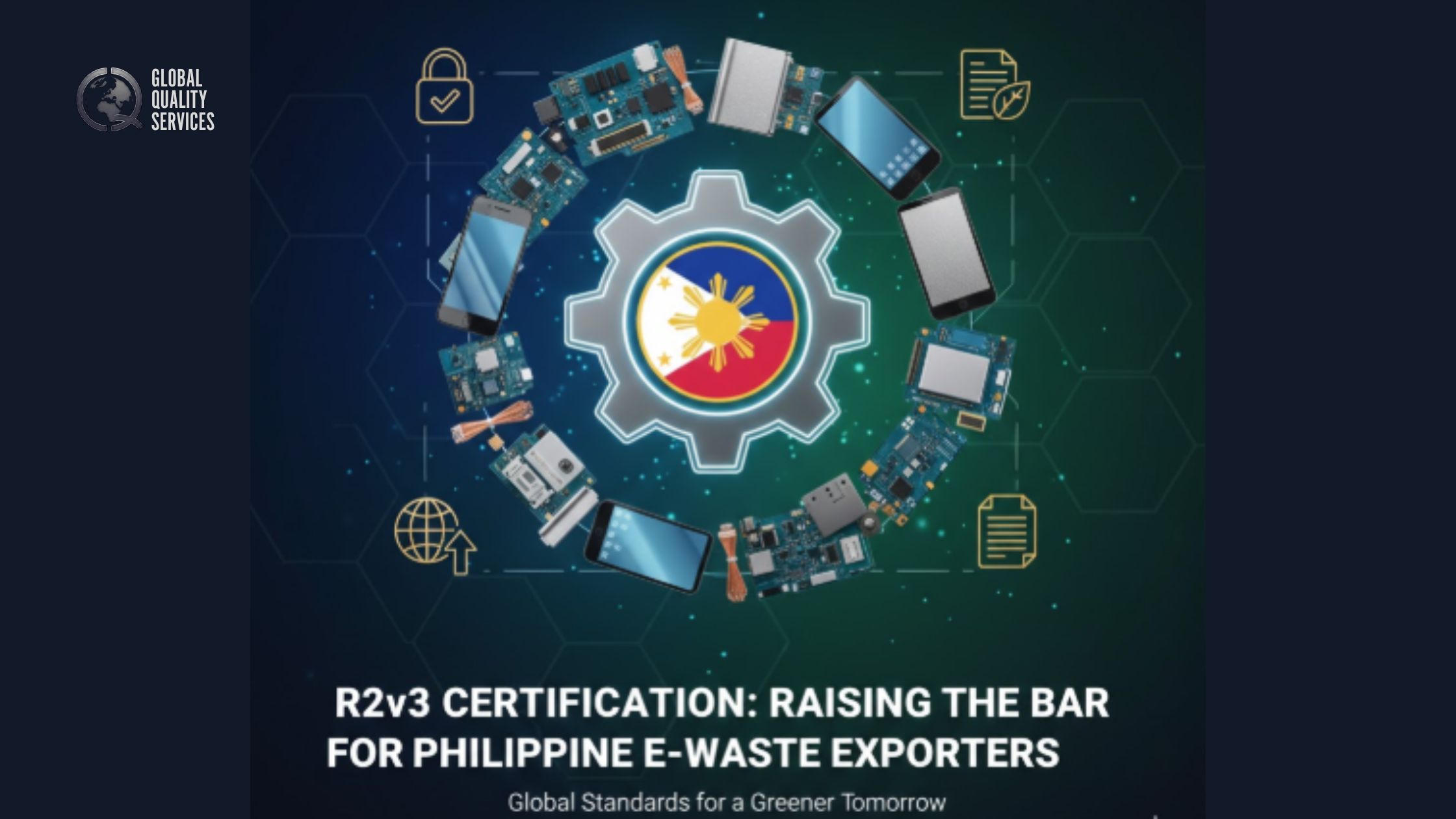

Philippines is emerging as a critical hub for both e-waste generation and recovery. For local recyclers and exporters, staying competitive means moving beyond basic compliance toward global excellence. The R2v3 (Responsible Recycling Version 3) Certification is the gold standard for this transition.
As a company committed to high standards, achieving R2v3 is your most powerful tool to prove that your “2-star” starting point is just the beginning of a journey toward world-class operational integrity.
What is R2v3? An Overview
R2v3 is the latest evolution of the Responsible Recycling standard managed by SERI (Sustainable Electronics Recycling International). Unlike previous versions, v3 is more prescriptive, focusing heavily on data security, logical and physical asset protection, and transparent downstream accountability.
For Philippine recyclers, this isn’t just a badge; it’s a management system that integrates environmental, health, and safety (EHS) protocols with rigorous technical requirements for testing, repair, and materials recovery.
Environmental Compliance in the Philippines
Philippine recyclers must navigate a complex regulatory environment governed by the DENR-EMB. R2v3 aligns perfectly with local mandates such as:
-
Republic Act 9003: The Ecological Solid Waste Management Act.
-
RA 6969: The Toxic Substances and Hazardous and Nuclear Wastes Control Act.
-
The EPR Law (RA 11898): Which now requires large enterprises to have verifiable recovery programs for their plastic and packaging footprints.
By obtaining R2v3, you automatically build the documentation needed to prove compliance with these local laws to the DENR, simplifying your annual reporting.
The Documentation Powerhouse
Documentation is the “spine” of R2v3. To pass an audit, a Philippine recycler must maintain:
-
Legal Basis: Proof of all local permits (ECC, Discharge Permits, Permit to Operate).
-
Downstream Vendor (DSV) Due Diligence: Verifiable proof that your exporters or local processors are also handling materials responsibly.
-
Data Sanitization Records: Serialized certificates of destruction or sanitization for every data-bearing device.
-
Material Flow Records: A “mass balance” report showing exactly how much e-waste entered your facility and where every gram ended up.
Navigating the Audit Process
The path to R2v3 certification involves a two-stage audit:
-
Stage 1 (Readiness Review): An auditor reviews your documentation and management system to ensure you are prepared.
-
Stage 2 (The Site Audit): A deep dive where the auditor observes your workers, checks safety equipment (like fire suppression and PPE), and verifies that your actual floor processes match your written policies.
Strategic Benefits for Exporters
For Philippine firms exporting to markets like Japan, the US, or Europe, R2v3 is often a mandatory requirement.
-
Reduced Liability: It shifts the risk. When you can prove your recycling chain is “R2 Certified,” you protect yourself from international legal blowback regarding toxic waste dumping.
-
Market Access: Many global OEMs (Original Equipment Manufacturers) will only contract with R2v3-certified facilities.
-
Optimized Value: The standard prioritizes Reuse > Refurbishment > Recycling. This helps your firm move up the value chain by selling functional components rather than just scrap metal.
5 Steps to Readiness

Conclusion: Elevating the Standard
For Philippine e-waste recyclers, R2v3 is more than a certification; it is a declaration of quality. In a world where “greenwashing” is common, R2v3 provides the transparency and data-backed proof that your firm is a leader in the circular economy.
By starting your readiness steps today, you transform your company from a local recycler into a global partner of choice with Global Quality Services.


