

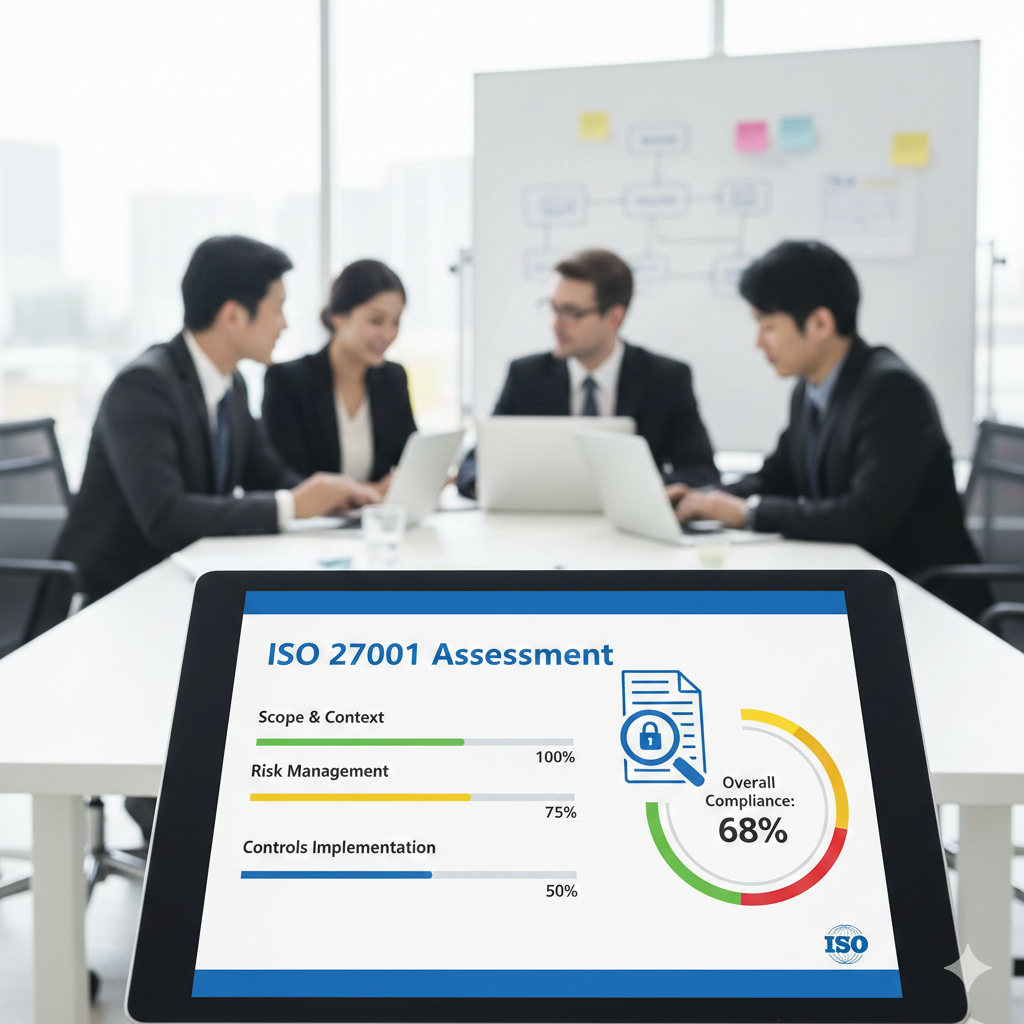

ISO 27001 has shifted from being a “nice-to-have” compliance badge to a practical security requirement for Filipino organizations that handle customer data, financial information, or digital operations. In 2026, clients, regulators, and foreign partners are increasingly asking for proof of an effective Information Security Management System (ISMS), and ISO 27001 remains the most recognized global framework for demonstrating it.
This guide explains how ISO 27001 assessments work, the risks they address, the opportunities they unlock for Philippine businesses, and how local companies can simplify certification and maintenance without incurring excessive costs or complexity.
What Is ISO 27001?
ISO 27001 is an international standard that defines how organizations should manage information security through policies, controls, and continuous monitoring. It requires companies to identify security risks, select appropriate safeguards, and verify that these controls work in practice.
ISO 27001 does not dictate technologies or tools. It focuses on:
-
What needs to be protected
-
What risks exist
-
How controls prevent or reduce those risks
-
How improvements are maintained over time
This makes it compatible with Philippine industries ranging from BPO and fintech to e-commerce, healthcare, manufacturing, and government suppliers.
Why ISO 27001 Matters in the Philippines (2026)
Three 2026 realities drive adoption in the Philippines:
-
Growing digital exposure – cloud migration, hybrid work, and digital banking increase attack surfaces.
-
Rising regulatory pressure – Data Privacy Act enforcement is stricter, and sector regulators now ask for structured security compliance.
-
Globalization of supply chains – foreign clients expect Philippine organizations to demonstrate secure data handling.
Most importantly, ISO 27001 is becoming a requirement in:
-
BPO contracts
-
Payment and fintech partnerships
-
Healthcare data processing
-
Software development outsourcing
-
GovTech procurement
-
International vendor onboarding
For many Filipino companies, ISO 27001 is now a gatekeeper to bigger deals.
Benefits of ISO 27001 for Filipino Organizations
The standard provides tangible operational and commercial benefits:
1. Reduced cyber risks
Phishing, ransomware, credential abuse, and insider threats remain common in the local environment. ISO 27001 reduces exposure by enforcing structured controls around access, backups, incident response, and monitoring.
2. Easier client onboarding
Clients, especially in foreign markets, are reluctant to work with suppliers without verifiable security controls. ISO cuts negotiation time and due diligence.
3. Competitive advantage
In crowded BPO, software, and cloud markets, certification differentiates genuine security maturity from marketing claims.
4. Smoother regulatory compliance
ISO supports compliance for:
-
Data Privacy Act (Philippines)
-
DICT cybersecurity strategies
-
Sectoral rules (BSP, NPC, healthcare)
-
International requirements (HIPAA, GDPR, PCI)
5. Business continuity improvements
ISO requires identifying critical functions, dependencies, and recovery plans — critical for an archipelago vulnerable to typhoons, outages, and transport disruptions.
ISO 27001 Risks and Opportunities in the Philippines (SEO Target Section)
Local adoption creates both risk reduction and business opportunity.
Risks ISO 27001 Helps Address
Filipino organizations face specific security threats:
-
Ransomware targeting hospitals and LGUs
-
BEC scams in exporters and BPO finance teams
-
Credential theft from phishing and SMS lures
-
Disgruntled insiders leaking or deleting data
-
Unsecured third-party software integrations
-
Cloud misconfigurations from rapid migration
ISO 27001 mitigates these via structured controls such as:
-
Role-based access policies
-
MFA and identity management
-
Change management
-
Backup and recovery controls
-
Vendor and third-party risk management
-
Incident escalation procedures
Opportunities Unlocked Through Certification
ISO certification allows Philippine companies to:
-
Bid for international contracts
-
Qualify as long-term IT/BPO vendors
-
Onboard fintech/healthcare clients faster
-
Expand into regulated markets
-
Increase trust with foreign investors
-
Reduce cyber insurance premiums
These factors explain why certifications are rising across BPO, fintech, cloud IT, and software firms in Metro Manila, Cebu, and Davao.
2026: Why ISO 27001 is Easier Than Before
Historically, ISO was seen as slow and expensive. Today, adoption is simpler for three reasons:
-
Cloud-native tooling reduces manual documentation and logging.
-
Remote audits eliminate long site visits and logistical cost.
-
Standardized playbooks provide ready-made policies, controls, and asset registers.
Even certification bodies servicing the Philippines have modernized, offering:
-
Online gap assessments
-
Digital evidence submissions
-
Remote surveillance audits
-
Year-round compliance dashboards
This shifts ISO 27001 from a 12–18 month burden to a realistic 90–150 day project for many organizations.
How ISO 27001 Assessments Work (Explained Simply)
An ISO 27001 assessment follows five key phases:
Phase 1: Gap Analysis
Auditors compare your current processes against ISO requirements to identify missing controls, documentation gaps, and weaknesses.
Phase 2: ISMS Implementation
The company creates or updates policies, risk assessments, asset inventories, and control procedures.
Phase 3: Internal Audit
A separate internal function validates readiness before the external audit happens.
Phase 4: Certification Audit
The accredited certification body reviews evidence, interviews staff, and verifies control effectiveness.
Phase 5: Surveillance Audits
Performed annually to ensure the company maintains conformity.
Surveillance matters because ISO is a continuous management system, not a one-time badge.
Core Requirements Filipino Organizations Must Meet
ISO 27001 requires organizations to establish an Information Security Management System (ISMS) covering:
-
Scope definition
-
Leadership roles
-
Security objectives
-
Risk assessment methodology
-
Treatment plans
-
Documentation controls
-
Monitoring & improvement processes
Annex A defines 93 security controls grouped into:
-
Organizational controls
-
People controls
-
Physical controls
-
Technological controls
Controls include MFA, secure coding, network logging, access reviews, backups, and vendor risk assessments — all relevant to Philippine digital operations.
Industries in the Philippines Actively Pursuing ISO 27001
Certification has grown fastest among:
-
BPO & Shared Services
-
Fintech & Payments
-
SaaS & Software Dev
-
Healthcare & Telemedicine
-
Banks & Lending
-
E-commerce & Marketplaces
-
Data Centers & Cloud Providers
-
Logistics & Supply Chain
-
Energy & Utilities
-
Universities handling research data
These sectors often handle sensitive personal data or financial information and face regulatory scrutiny.
Regulatory and Compliance Drivers in the Philippines
Several Philippine regulations align indirectly with ISO 27001:
1. Data Privacy Act (NPC)
Requires breach notification, secure processing of personal data, and risk-based controls.
2. DICT Cybersecurity Strategies
Encourage sector-based resilience and national cyber maturity initiatives.
3. BSP Sectoral Rules
Banks, lenders, and PSPs are expected to manage operational risk and cybersecurity using frameworks aligned with ISO standards.
4. Healthcare Data Requirements
Hospitals and clinics that process sensitive data are expected to follow structured ISMS rules to ensure continuity and prevent breaches.
ISO 27001 provides a unified framework that makes these fragmented requirements manageable.
Local Challenges Filipino Organizations Face
Adoption in the Philippines isn’t frictionless. Common barriers include:
-
Limited internal security resources
-
Weak documentation culture
-
Ad-hoc incident response
-
Poor asset inventories
-
Heavy outsourcing dependencies
-
Multi-site coordination across regions
-
Vendor shadow IT risks
-
Legacy system constraints
However, these challenges are exactly why structured frameworks matter — they impose discipline on environments that grew without centralized governance.
How Organizations in the Philippines Can Simplify ISO 27001
The fastest implementations follow a structured approach:
Step 1: Establish Scope
Define which departments, locations, and systems are included.
Step 2: Build Asset Inventory
Catalog systems, applications, users, and dependencies.
Step 3: Conduct Risk Assessment
Identify threats, impacts, likelihood, controls, and residual risk.
Step 4: Assign Ownership
Compliance fails when no one owns a control. Role mapping solves this.
Step 5: Develop Policies
Align policies to ISO rather than reinvent from scratch.
Step 6: Run Internal Audit
Fix gaps before certification to avoid expensive nonconformities.
Common Audit Findings in Philippine Organizations
Auditors commonly flag:
-
No structured incident response plan
-
MFA not enforced on critical systems
-
No periodic access review logs
-
Unsecured third-party services
-
Weak change management processes
-
Outdated asset inventories
-
Training not documented
-
Missing breach reporting procedures
Each issue increases operational and legal exposure and may delay certification.
Cost Considerations for Filipino Companies
ISO 27001 cost varies based on:
-
Company size
-
Scope coverage
-
Remote vs on-site audits
-
Tooling vs manual processes
-
Certification body selection
For most SMBs/BPOs in Manila or Cebu:
-
Initial certification: 4–7 months
-
Certification fees: PHP 250,000 – 1.5M
-
Annual surveillance: PHP 120,000 – 800,000
-
Tools & training optional but recommended
Large enterprises can exceed these due to multi-site scope and heavy cloud reliance.
Post-Certification Requirements
ISO 27001 requires ongoing activities such as:
-
Annual risk reviews
-
Internal audits
-
Management review meetings
-
Corrective actions
-
Security awareness training
-
Third-party risk assessments
-
Incident logs and root cause analysis
Organizations that treat ISO as a “project” instead of a “system” often fail on surveillance audits.
Conclusion: ISO 27001 Strengthens Security and Market Access in the Philippines
ISO 27001 has evolved into a practical tool for reducing risk, winning clients, and aligning with regulatory expectations in the Philippines. With modern remote auditing, cloud evidence collection, and templated ISMS playbooks, it is far easier to implement today compared to even five years ago.
Organizations that adopt ISO early gain better cybersecurity posture, smoother compliance journeys, and improved trust in both local and international markets. For companies operating in sectors like fintech, software, healthcare, and BPO, certification is no longer an optional investment — it is quickly becoming a prerequisite for growth.


