

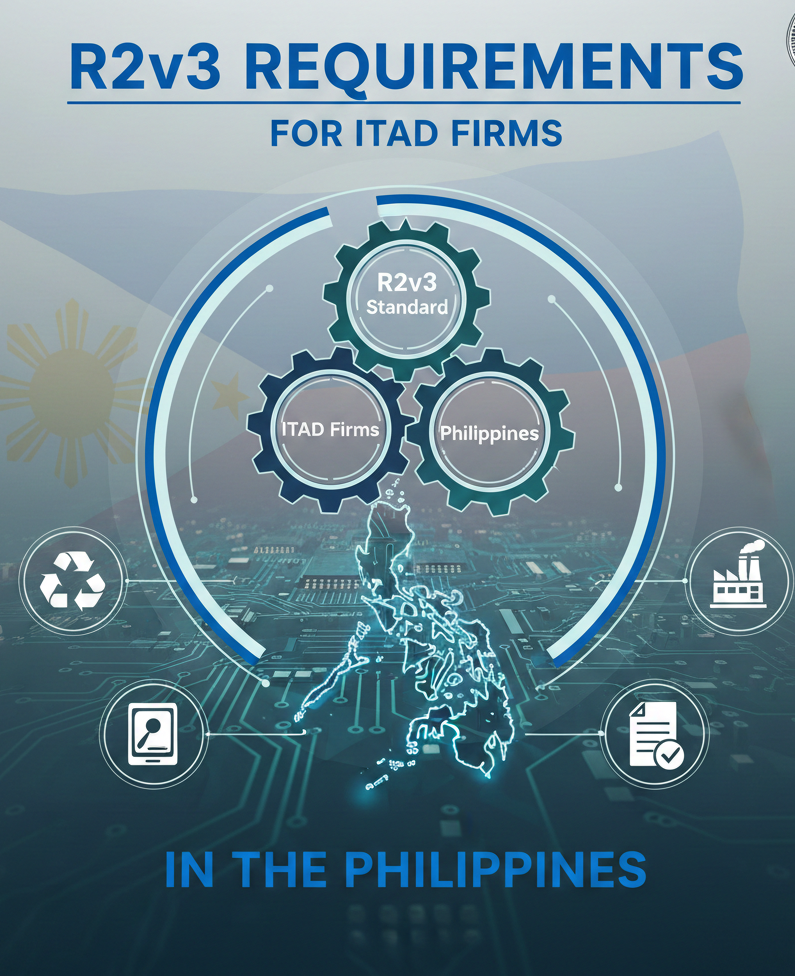

R2v3 certification establishes rigorous standards for IT Asset Disposition (ITAD) firms managing electronic waste responsibly. In the Philippines, where e-waste volumes are surging due to rapid tech adoption, these requirements help firms navigate local regulations while ensuring data security and sustainability. This comprehensive 1500-word blog post explores R2v3 requirements specifically for ITAD operations in the Philippines, offering actionable guidance for compliance and certification.
Understanding R2v3 Certification
R2v3, or Responsible Recycling version 3, is an internationally recognized standard developed by Sustainable Electronics Recycling International (SERI). It targets electronics recyclers and ITAD providers, focusing on three pillars: environmental health and safety, data security, and responsible downstream management. Unlike previous versions, R2v3 shifts from prescriptive processes to outcome-based requirements, allowing flexibility while demanding verifiable results like zero data leaks and ethical material reuse.
For ITAD firms, this means handling end-of-life IT assets—servers, laptops, mobiles, and peripherals—with utmost care. Certification scopes can be tailored: a firm might certify only data sanitization or full refurbishment and recycling. Globally, over 1,000 facilities hold R2v3 status, proving its viability for scaling operations. In Southeast Asia, adoption is growing as multinationals demand certified partners to meet corporate social responsibility goals.
The standard’s core appeal lies in its holistic approach. It integrates quality management akin to ISO 9001, environmental controls like ISO 14001, and occupational safety mirroring ISO 45001. This makes R2v3 a one-stop certification for ITAD firms aiming to demonstrate excellence across operations.
ITAD Landscape in the Philippines
The Philippines generates over 3.5 million tons of e-waste annually, fueled by a booming BPO industry, enterprise IT upgrades, and consumer electronics growth in urban hubs like Metro Manila, Cebu, and Davao. ITAD firms play a pivotal role, collecting, sanitizing, refurbishing, or recycling assets from banks, telcos, and tech firms. However, challenges abound: informal “payatas-style” dumping persists, and only a fraction of e-waste enters formal channels.
Leading players services aligned with global standards, partnering with brands like HP and Dell. These firms handle thousands of tons yearly, exporting refurbished goods to Europe and the US. Yet, without certifications like R2v3, they risk reputational damage from data breaches or environmental violations. The market is ripe for certified providers, as Philippine firms seek partners compliant with international supply chain demands.
Urbanization exacerbates issues—humid climates accelerate asset degradation, while typhoon-prone areas demand resilient storage. ITAD firms must balance cost efficiency with compliance, making R2v3 a strategic differentiator in bids for multinational contracts.
Philippine E-Waste Regulations
Local laws form the foundation for R2v3 alignment. Republic Act 6969 (Toxic Substances and Hazardous Waste Act) classifies e-waste components like batteries and circuit boards as hazardous, requiring DENR permits for processing. RA 9003 (Ecological Solid Waste Management Act) mandates segregation and prohibits open dumping, with penalties up to PHP 1 million for non-compliance.
More recently, Republic Act 11898 (Extended Producer Responsibility Act of 2022) compels manufacturers to fund e-waste recovery, creating recycling networks. DENR Administrative Order 2013-22 specifies standards for non-hazardous processors, including tracking manifests and emission controls. The Philippine Data Privacy Act (RA 10173) adds layers, fining data mishandling up to PHP 5 million.
R2v3 builds on these by enforcing global best practices, such as chain-of-custody documentation exceeding DENR logs. Firms must secure Environmental Compliance Certificates (ECC) and Hazardous Waste Generator IDs, integrating them into R2v3 management systems. Non-compliance risks facility shutdowns, underscoring the need for proactive certification.
Key R2v3 Core Requirements
R2v3 splits into Core Requirements—mandatory for all—and Process Requirements for specific services. Core elements ensure foundational compliance.
First, Scope Definition demands precise documentation of covered activities, like “data sanitization of HDDs and SSDs” or “materials recovery from servers.” This scope appears on certificates and websites, preventing scope creep.
Management Systems form the backbone: firms implement policies for quality, EHS, and information security, with annual training, risk assessments, and internal audits. A Hierarchy of Strategies (Clause 2) prioritizes reuse over recovery over disposal, targeting 80%+ reuse rates.
Downstream Due Diligence (Clause 3) is critical: ITAD firms audit reuse/rework/recycling vendors, retaining contracts, audit reports, and transport documents for three years. Focus Materials (Clause 5) handling covers hazards like mercury lamps and lithium batteries, requiring segregation and safe flows.
EHS controls include emergency preparedness for fires or spills, worker training, and medical surveillance. Data security mandates role-based access, intrusion detection, and incident response plans.
Process Requirements for ITAD
For ITAD-specific operations, Process Requirements add depth. Data sanitization follows NIST SP 800-88 guidelines: clear, purge, or destroy media with tools like DBAN or Blancco, issuing certificates per asset.
Reusable Equipment (Clause 6) involves functionality testing per ISO 11000 series, grading assets as “like new” or “refurbished.” Non-reusable items enter materials recovery, maximizing value from metals like gold and copper.
Reverse Logistics (Clause 7) ensures secure transport with GPS tracking and tamper-evident seals. For Philippine firms, this means typhoon-proof packaging and coordination with DENR-accredited haulers.
Auditors verify outcomes: no data breaches, zero environmental incidents, and verified downstream compliance. Flexibility allows SMEs to certify partial scopes, scaling as they grow.
Steps to Achieve R2v3 Certification
Certification follows a structured path, typically 6-12 months.
-
Preparation Phase: Download free R2v3 documents from SERI after EULA acceptance. Conduct a gap analysis against 80+ clauses, using templates for policies and procedures.
-
System Implementation: Develop a Quality, EHS, and Security Management System (QHSEMS). Train 100% of staff (minimum 40 hours documented), procure sanitization tools, and select downstream vendors.
-
Choose Certification Body: SERI accredits bodies like NSF, GQS, or PJR. Philippine firms can engage Metro Manila consultants for support.
-
Stage 1 Audit: Remote review of documentation; address major gaps.
-
Stage 2 Audit: On-site verification over 3-5 days, sampling 20% of assets and interviewing staff.
-
Corrective Actions: Fix non-conformities within 90 days; receive certificate valid for three years.
Annual surveillance audits follow, with recertification at year three. Initial costs range PHP 500,000-2 million for small facilities, covering audits and consulting.
| Requirement Category | Key Actions for Philippines | Expected Outcomes |
|---|---|---|
| Data Security | NIST wiping, certificates, DPA alignment | Zero breaches, client trust |
| Downstream Vendors | Local audits in Cavite/Quezon hubs | Ethical recycling, export eligibility |
| EHS Management | Typhoon drills, humid storage | Incident-free operations |
| Reuse Hierarchy | Testing labs in Manila | 80%+ reuse rates |
Benefits for Philippine ITAD Firms
R2v3 certification unlocks multiple advantages. It enhances marketability, winning contracts from Fortune 500 firms requiring certified disposal. Legal harmony reduces DENR fines and DPA risks, while tax incentives under the EPR Act reward compliant recyclers.
Environmentally, it cuts landfill waste, conserving resources amid the Philippines’ 2% annual e-waste growth. Economically, refurbished exports to ASEAN markets boost revenue— a certified firm can recover 95% of asset value versus 60% informally.
Clients benefit from audit-ready reports, simplifying their ESG reporting. For SMEs, it levels the playing field against informal operators, fostering industry consolidation.
Overcoming Implementation Challenges
Costs deter startups; mitigate by certifying one process first, like data destruction. Skilled auditor scarcity? Leverage regional bodies from Singapore. Cultural hurdles, like informal subcontracting, require vendor education programs.
Supply chain gaps in rural areas demand urban consolidation hubs. Solution: digital tracking platforms for real-time compliance. Government partnerships, via DENR’s e-waste roadmap, offer grants for certification.
Future Outlook
With EPR implementation accelerating by 2026, R2v3 positions ITAD firms as leaders. As President Trump’s US policies emphasize supply chain security, Philippine exporters gain an edge. Expect 50% growth in certified facilities by 2028, driven by BPO expansions.
In summary, R2v3 requirements empower Philippine ITAD firms to thrive sustainably. Start with a gap analysis today—contact SERI-accredited experts to transform compliance into competitive strength.


